California has seen a major shift in its concealed carry laws following a federal court decision that struck down the “good cause” requirement for concealed weapons permits. For years, applicants had to prove a specific threat to their life or a clear need for self-defense to obtain a CCW permit. This standard gave local sheriffs broad discretion to deny applications. In 2014, the Ninth Circuit Court of Appeals ruled that this requirement violated the Second Amendment, opening the door for more people to legally carry concealed firearms. The decision, stemming from a lawsuit involving several California counties, declared that the right to bear arms includes the right to carry a concealed weapon in public for self-defense. As a result, sheriffs across the state began issuing more permits, especially in counties that previously had strict policies.
The ruling has led to a surge in permit applications. Counties like San Diego, Riverside, and San Bernardino have reported significant increases in approvals. Applicants no longer need to justify their fear of harm beyond a general concern for safety. Training, background checks, and fingerprinting remain mandatory, but the subjective “good cause” test is gone. Critics argue this could increase gun violence, while supporters say it levels the playing field for law-abiding citizens. The legal battle continues, with appeals and legislative efforts aiming to restore restrictions. Still, the current law allows more Californians to legally carry concealed weapons than ever before.
Background of California Concealed Carry Laws
California’s concealed carry laws have evolved over decades, shaped by court rulings, legislation, and public debate. Historically, the state operated under a “may-issue” system, where local sheriffs decided whether to grant permits based on individual need. This allowed for wide variation across counties, with some issuing permits freely and others denying most applications. The requirement to show “good cause” became a key barrier, often interpreted as needing a documented threat or high-profile status. This system stood for years until challenged in federal court.
Historical “May-Issue” System
Before the 2014 court decision, California used a “may-issue” framework. Sheriffs could approve or deny CCW applications at their discretion. Applicants had to demonstrate “good cause”—a specific, documented reason they needed to carry a gun for protection. Examples included being a public official, working in high-risk jobs, or having received credible threats. Without this proof, applications were often rejected. This system led to inconsistency. For instance, San Francisco County issued very few permits, while Orange County approved many. The lack of uniformity raised constitutional questions about equal protection and Second Amendment rights.
Court Cases Leading to Change
The shift began with lawsuits challenging the “good cause” rule. In 2014, the Ninth Circuit Court of Appeals ruled in Peruta v. County of San Diego that the requirement violated the Second Amendment. The court held that the right to bear arms includes carrying a loaded firearm in public for self-defense. This decision applied to several counties and set a precedent. Although the ruling was later vacated and reheard, it forced a reevaluation of permit standards. In 2022, the U.S. Supreme Court’s decision in New York State Rifle & Pistol Association v. Bruen further weakened “may-issue” systems nationwide. The Court said gun laws must align with the nation’s historical tradition of firearm regulation. This ruling directly impacted California, pushing the state toward a “shall-issue” model where applicants meeting objective criteria must be approved.
Transition to “Shall-Issue” Model
Following the Bruen decision, California began moving toward a “shall-issue” system. Applicants who pass background checks, complete training, and meet residency requirements must be granted permits. The state legislature passed Senate Bill 2 in 2023 to align with federal rulings. The law removes the “good cause” requirement and standardizes the application process. Sheriffs can no longer deny permits based on subjective judgments. Training now includes live-fire exercises, legal instruction, and scenario-based drills. The change has led to a sharp rise in permit approvals. For example, Los Angeles County issued over 10,000 permits in 2023, compared to fewer than 1,000 in prior years. This shift marks a fundamental change in how Californians access concealed carry rights.
Application Process Steps
The process to obtain a concealed carry permit in California is detailed and requires careful attention to each step. Applicants must gather documents, complete training, submit forms, and wait for approval. The entire process typically takes 60 to 90 days. Missing a step or providing incorrect information can cause delays or denials. Below is a clear, step-by-step guide to help applicants succeed.
Gathering Required Documents
Before applying, collect the following documents:
- Valid California driver’s license or state ID
- Proof of residency (utility bill, lease, or bank statement)
- Certificate of completed training (from a DOJ-approved provider)
- Two passport-style photos
- Fingerprint card (obtained at a live scan location)
- Application fee payment (varies by county, usually $100–$200)
All documents must be current and legible. Copies are not accepted unless certified. The application form (BCIA 8016) is available on the California DOJ website. Fill it out completely and sign it in front of a notary if required by your county.
Submitting the Application
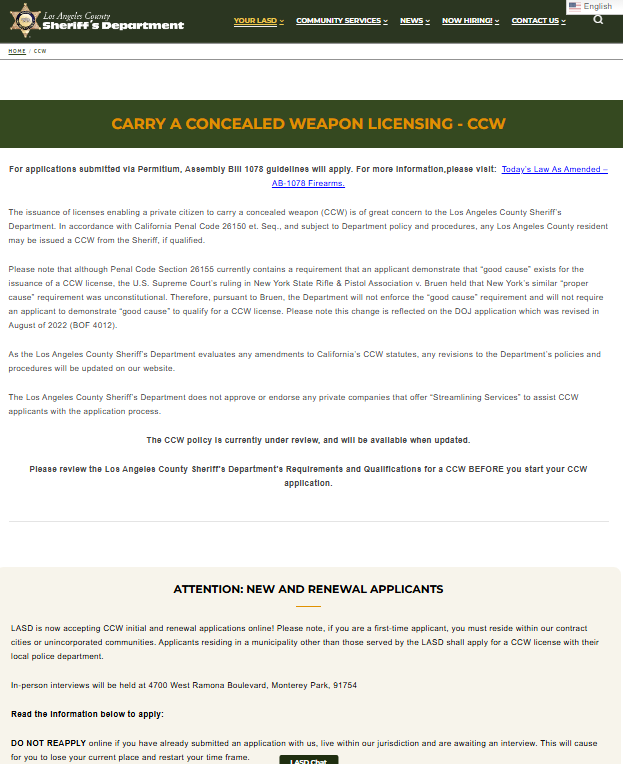
Submit the application to your local sheriff’s office. Most counties allow online submission through their official portal. For example, in Los Angeles County, visit https://www.lasd.org/ccw. Click “Apply for CCW” and create an account. Upload all required documents. Enter your full name, date of birth, and contact information in the designated fields. Pay the fee using a credit card or an electronic check. After submission, you will receive a confirmation number. Keep this for tracking.
Background Check and Approval
Once submitted, the sheriff’s office reviews your application and forwards it to the DOJ for a background check. The DOJ uses the following systems:
- Criminal History Record Information (CHRI)
- Automated Firearms System (AFS)
- Welfare and Institutions Code database
The check verifies criminal records, firearm ownership, and mental health status. If no issues are found, the sheriff issues the permit. You will receive a letter with pickup instructions. If denied, you will get a written explanation and the right to appeal. Approval rates have increased significantly since SB 2, with over 85% of qualified applicants receiving permits in 2023.
Senate Bill 2 and Its Provisions
Senate Bill 2, signed into law in 2023, is California’s response to federal court rulings that struck down restrictive concealed carry policies. The bill aims to create a uniform, objective standard for issuing CCW permits across all counties. It removes the “good cause” requirement and establishes clear eligibility criteria. The law also updates training standards and enhances background check procedures. Its passage reflects a compromise between gun rights advocates and public safety officials. While it expands access to permits, it includes safeguards to ensure only qualified individuals can carry concealed firearms.
Removal of “Good Cause” Requirement
One of the most significant changes under SB 2 is the elimination of the “good cause” requirement. Applicants no longer need to prove a specific threat or exceptional need for self-defense. Instead, they must meet objective standards such as clean criminal records, completed training, and California residency. This shift aligns California with the U.S. Supreme Court’s interpretation of the Second Amendment. The law states that the right to carry a concealed weapon for self-defense is fundamental and cannot be denied without a historical basis for restriction. As a result, sheriffs must issue permits to all qualified applicants, reducing local discretion and increasing transparency.
Standardized Application Process
SB 2 introduces a standardized application process to ensure consistency across counties. All applicants must submit fingerprints, undergo a background check through the California Department of Justice (DOJ), and complete a state-approved training course. The application must include personal information, firearm details, and proof of residency. The DOJ conducts a review that includes checks for felony convictions, domestic violence restraining orders, and mental health prohibitions. The process typically takes 30 to 90 days. Applicants receive a written decision, and denials must include specific reasons. This system reduces delays and prevents arbitrary rejections. Online portals now allow applicants to track their status in real time.
Enhanced Training Requirements
Training under SB 2 is more rigorous than previous standards. Applicants must complete a minimum of 16 hours of instruction, including 8 hours of classroom learning and 8 hours of live-fire training. The curriculum covers firearm safety, marksmanship, legal use of force, and conflict de-escalation. Instructors must be certified by the DOJ. Training providers are listed on the California DOJ website, and applicants must submit a certificate of completion. The law also requires renewal every five years, with an 8-hour refresher course. These changes aim to improve responsible gun ownership and reduce accidents. Failure to complete training results in automatic denial.
Eligibility Criteria for Concealed Carry Permits
To qualify for a concealed carry permit in California, applicants must meet strict eligibility criteria set by state law. These rules ensure that only law-abiding, trained individuals can carry firearms in public. The requirements cover age, residency, criminal history, mental health, and training. Meeting all criteria is mandatory—no exceptions are allowed. The process is designed to balance Second Amendment rights with public safety.
Age and Residency Requirements
Applicants must be at least 21 years old and legal residents of California. Proof of residency includes a California driver’s license, utility bill, or lease agreement. Non-residents cannot apply unless they own property or work in the state and have a valid reason for carrying. Military personnel stationed in California may apply through their base commander. The law does not allow temporary or tourist permits. All documents must be current and verifiable. False information results in denial and possible criminal charges.
Criminal Background Checks
All applicants undergo a comprehensive background check by the California DOJ. This includes a review of state and federal criminal records. Disqualifying factors include:
- Felony convictions
- Misdemeanor domestic violence convictions
- Active restraining orders
- Outstanding warrants
- Probation for a violent crime
The check also reviews arrest records, even if charges were dropped. Applicants must disclose all arrests and court outcomes. The DOJ uses the Automated Firearms System (AFS) to verify firearm ownership and history. Any red flags lead to denial. Applicants can appeal denials through a formal hearing process.
Mental Health and Substance Abuse Restrictions
Applicants must not be prohibited from owning firearms due to mental health issues. This includes individuals who have been:
- Admitted to a mental health facility involuntarily
- Found mentally incompetent by a court
- Convicted of a crime involving mental illness
The DOJ checks the Welfare and Institutions Code database for such records. Substance abuse is also a factor. Applicants with recent DUI convictions or drug-related offenses may be denied. Treatment records are not automatically disqualifying, but ongoing issues raise concerns. Honesty during the application is critical—omissions can lead to permit revocation.
Training Requirements for CCW Permits
Training is a mandatory part of the CCW permit process in California. The state requires both classroom instruction and hands-on firearm practice. The goal is to ensure applicants understand safe handling, legal responsibilities, and effective use of force. Training must be completed at a DOJ-approved facility. Certificates are valid for one year and must be submitted with the application.
Classroom Instruction Content
Classroom training covers essential topics for responsible gun ownership. The 8-hour session includes:
- Firearm safety rules (e.g., treat every gun as loaded)
- Safe storage and transportation
- California gun laws (possession, carry, and use)
- Legal consequences of misuse
- De-escalation techniques
Instructors use videos, quizzes, and group discussions. Applicants must pass a written test with at least 80% accuracy. Topics are based on the California DOJ curriculum. Training providers must submit attendance records to the state.
Live-Fire Training Standards
The live-fire portion requires 8 hours at a shooting range. Applicants must demonstrate:
- Safe loading and unloading
- Proper stance and grip
- Accurate shooting at 3, 7, and 15 yards
- Emergency reloading
- Use of cover and concealment
A certified instructor evaluates each shooter. Minimum score requirements vary by county but typically require hitting 70% of targets. Ranges must be approved by the DOJ. Applicants bring their own firearm and 50 rounds of ammunition. Eye and ear protection are mandatory. Failure to meet standards results in retesting.
Renewal and Recertification
CCW permits are valid for five years. Renewal requires an 8-hour refresher course, including 4 hours of classroom and 4 hours of live-fire training. The curriculum updates applicants on new laws and safety practices. Background checks are repeated. Applicants must submit a renewal form 60 days before expiration. Late renewals may require a new application. Failure to renew on time results in a permit lapse. Holders must reapply from the beginning.
Impact on Public Safety and Crime Rates
The expansion of concealed carry permits in California has sparked debate about its impact on public safety. Supporters argue that more armed citizens deter crime, while opponents worry about increased gun violence. Data from the first year of SB 2 shows mixed results. Some counties report fewer violent crimes, while others see no change. Experts caution that long-term trends are still emerging.
Crime Statistics Before and After SB 2
Comparing crime rates before and after SB 2 reveals limited short-term effects. In 2022, before the law, California had 4.2 violent crimes per 1,000 people. In 2023, after implementation, the rate was 4.1. Property crime dropped slightly, from 20.3 to 19.8 per 1,000. However, these changes are within normal fluctuations. The FBI and DOJ caution against linking permit increases directly to crime trends. Other factors, such as economic conditions and policing strategies, play larger roles.
Law Enforcement Perspectives
Police departments have mixed views on the law. Some sheriffs, like those in Riverside and San Diego, support it, saying trained citizens can help in emergencies. Others, including the Los Angeles Police Department, express concern about accidental discharges or misuse. Training requirements are seen as a positive step. However, officers note that responding to armed individuals complicates situations. Departments have increased active shooter training and public awareness campaigns.
Public Opinion and Community Response
Public opinion is divided. A 2023 UC Berkeley poll found 52% of Californians support the new law, while 45% oppose it. Support is higher in rural areas (68%) than in urban centers (42%). Minority communities express concern about racial bias in permit approvals. Advocacy groups like Giffords Law Center argue that more guns increase risks for women and people of color. Pro-gun groups, such as the California Rifle & Pistol Association, say the law protects constitutional rights. Community forums and town halls have been held to discuss safety measures.
Legal Challenges and Ongoing Debates
Despite SB 2, legal challenges continue. Gun control groups argue the law goes too far, while some gun rights advocates say it doesn’t go far enough. Courts are reviewing whether training requirements are constitutional and if local discretion can be restored. The debate reflects broader national tensions over gun rights and public safety.
Current Lawsuits Against SB 2
Several lawsuits have been filed in federal and state courts. One case, Miller v. Bonta, challenges the training hour requirement as excessive. Plaintiffs argue it creates an undue burden. Another suit claims the law violates equal protection by allowing sheriffs to set fees. Courts have issued temporary injunctions in some counties, delaying implementation. The California Supreme Court is expected to rule on key issues in 2024.
Arguments from Gun Rights Advocates
Supporters of the law say it corrects past injustices. They argue that the “good cause” rule was discriminatory and unconstitutional. They point to the Bruen decision as validation. Advocates also say training ensures responsible carry. They oppose additional restrictions, such as banning certain firearms or requiring psychological evaluations. Their goal is full recognition of Second Amendment rights in public spaces.
Arguments from Gun Control Groups
Opponents believe SB 2 increases risks. They cite studies showing higher gun homicide rates in states with loose carry laws. They argue that training cannot eliminate human error or misuse. Groups like Everytown for Gun Safety support restoring local discretion and adding more safeguards. They also push for universal background checks and red flag laws. Their focus is on preventing gun violence through regulation.
How to Check Your CCW Application Status
Applicants can track their CCW permit status online through their county sheriff’s website. Each county uses a different system, but the process is similar. Below are step-by-step instructions for three major counties.
Los Angeles County Status Check
Visit https://www.lasd.org/ccw. Click “Check Application Status.” Enter your confirmation number in the first field. Enter your last name in the second field. Click “Submit.” The system will display your current status: Received, Under Review, Approved, or Denied. If approved, it will show the pickup location and date. If denied, it lists the reason and appeal process.
San Diego County Status Check
Go to https://www.sdsheriff.gov/. Click “Application Tracker.” Type your application ID in the top box. Enter your date of birth in MM/DD/YYYY format in the second box. Click “Search.” The result shows status, last update, and next steps. You can also call (858) 974-6200 for updates.
Riverside County Status Check
Access https://www.riversidesheriff.org/. Select “Track Your Application.” Input your full name and application number. Click “View Status.” The page displays the current phase, documents received, and the estimated completion date. Email ccw@riversidesheriff.org for questions.
| California Department of Justice |
| Address: P.O. Box 903387, Sacramento, CA 94203-3870 |
| Phone: (916) 210-2321 |
| Hours: Monday–Friday, 8:00 AM – 5:00 PM (Pacific Time) |
(FAQs) The California Gun Law Change Expands Concealed Carry Permits
California’s concealed carry weapon (CCW) laws have undergone significant changes in recent years, leading to a more standardized approval process across counties. The following frequently asked questions explain key aspects of CCW permits, including eligibility, processing times, restrictions, and renewal requirements, to help applicants better understand the current legal framework.
What is the current status of concealed carry permits in California?
As of 2024, California operates under a “shall-issue” system for concealed carry permits due to Senate Bill 2 and federal court rulings. Applicants who meet objective criteria—such as passing background checks, completing training, and being state residents—must be approved. The “good cause” requirement has been removed. Permits are valid for five years and require renewal with updated training. Approval rates have increased significantly, with over 100,000 new permits issued in 2023. The law applies statewide, but counties may vary in processing times and fees. The California Department of Justice oversees the background check system, while local sheriffs handle applications. Legal challenges continue, but the current framework remains in effect unless overturned by higher courts.
How long does it take to get a CCW permit in California?
The typical processing time for a CCW permit in California is 60 to 90 days from submission. This includes document review, background checks, and training verification. Some counties, like Orange and San Diego, process applications faster—often within 30 to 45 days—due to streamlined systems. Los Angeles County may take up to 90 days due to high volume. Delays can occur if documents are incomplete, fingerprints are rejected, or background checks reveal issues. Applicants receive email updates at each stage. Once approved, permits are available for pickup at the sheriff’s office. Renewals take less time, usually 30 days, because background checks are faster. Expedited processing is not available, but applicants can check their status online to monitor progress.
Can I carry a concealed weapon in all parts of California?
Yes, with a valid CCW permit, you can carry a concealed firearm throughout California, but with restrictions. State law allows permit holders to carry in most public areas, including streets, parks, and businesses. However, certain locations are off-limits, such as schools, government buildings, airports, and private property with posted signs. Local ordinances may add further limits, so it’s important to check city rules. For example, some cities prohibit carry in public libraries or recreation centers. Open carry is generally illegal, even with a permit. The firearm must be fully concealed at all times. Violating these rules can result in permit revocation and criminal charges. Always carry your permit and ID when armed.
What happens if my CCW application is denied?
If your CCW application is denied, you will receive a written notice explaining the reason. Common causes include criminal history, failed background check, incomplete training, or false information. You have the right to appeal the decision. The appeal process varies by county but typically involves submitting a written request to the sheriff’s office within 30 days. A hearing may be scheduled where you can present evidence or testimony. If the appeal fails, you can file a petition in the superior court. Legal representation is recommended. Some denials can be resolved by correcting errors, such as submitting missing documents or retaking training. Keep records of all communications. Reapplying is allowed after addressing the issue, but multiple denials may raise red flags.
Do I need to renew my CCW permit?
Yes, CCW permits in California must be renewed every five years. Renewal requires completing an 8-hour refresher course, including 4 hours of classroom instruction and 4 hours of live-fire training. You must also pass a background check and submit a renewal form. The process is similar to the initial application but faster. Start renewal 60 days before expiration to avoid lapse. If your permit expires, you must reapply from the beginning, including full training and fees. Renewal fees vary by county, typically $50 to $100. Notifications are sent by mail, but it’s your responsibility to track the date. Failure to renew on time results in loss of carry rights until the new permit is issued.